Minimalism for People Who Actually Like Stuff: A Middle Path
The minimalism industry has spent a decade selling an aesthetic of absence. Empty countertops. Bare walls. Wardrobes compressed into a single drawer. The philosophy underneath is sound—intentionality over accumulation—but the execution has become a performance of privilege. As The Art of Manliness noted years ago, strict minimalism is largely for the well-off. If you can afford to replace anything you discard, ownership feels light. If you cannot, those duplicates and backups are not clutter; they are risk mitigation. The New Yorker echoed this in its analysis of the movement, observing that minimalism has become an aspirational and deluxe way of life, easily transformed from a philosophy of intentional restraint into an aesthetic language for walled-off luxury.
This is where the middle path enters. It is not a compromise. It is a rejection of the false dichotomy that says you must either live like a monk or drown in stuff. Most people are neither ascetics nor hoarders. They are simply collectors, hobbyists, parents, crafters, readers, and homeowners who want their possessions to serve them rather than bury them. The middle path does not ask you to stop liking stuff. It asks you to stop tolerating stuff you do not like. That distinction changes everything.
The Ownership Reality Check: What the Numbers Actually Say
Before adopting any system, you need to understand the scale of the problem. A 2025 YouGov survey reports that 40% of U.S. adults live in cluttered environments. The average adult loses 17 hours per year searching for misplaced items. The Journal of Environmental Psychology found that 42% of adults feel overwhelmed by visual disorder, with clutter directly correlated to increased cortisol and reduced life satisfaction.
Yet the same data reveals that the issue is not volume—it is mismanagement. The American Cleaning Institute found that 91% of Americans clean reactively before hosting guests, proving most households lack sustainable baseline systems. We do not own too much; we own too much passively. Items enter through impulse, inertia, and gift obligations, then never receive a verdict. They simply stay, migrating from drawer to closet to storage bin, accumulating emotional and spatial debt.
The middle path starts with this admission: some number of possessions is correct for you, and that number is not zero. A carpenter needs tools. A painter needs supplies. A host needs dishes. The question is not how few things you can survive with, but how many things you can thrive with before the maintenance cost exceeds the joy dividend. That threshold is personal, and it is allowed to be high if the usage is genuine.
The Three Traps of Strict Minimalism
To understand why the middle path works, you must first see why the extremes fail. Strict minimalism, for all its benefits, contains structural traps that punish ordinary people living ordinary lives. Recognizing them is liberation.
Trap One: The Poverty Privilege
The minimalist gospel is preached loudest by those who can afford to make mistakes. Discard the blazer; buy another later if needed. Ditch the backup hard drive; cloud storage is cheap when you have stable income. This logic collapses for anyone operating under constraint. As critics have pointed out, poor people do not have clutter because they are too dumb to see the virtue of living simply; they have it to reduce risk. A secondhand appliance in the garage is not hoarding; it is a hedge against the day the primary unit dies and replacement funds do not exist. The middle path respects this reality. It does not demand lightness at the expense of security.
Trap Two: Aesthetics Without Ethics
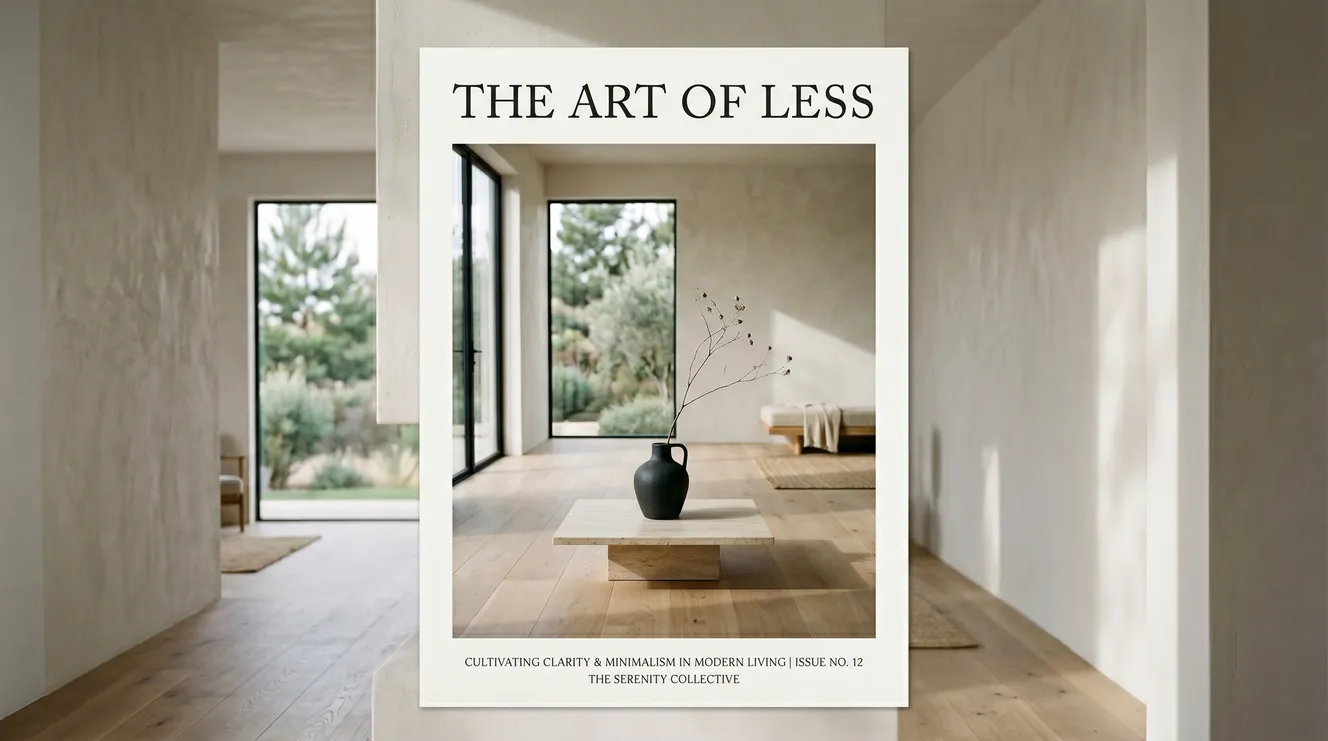
Instagram minimalism is a visual style masquerading as a philosophy. The monochrome palette, the empty floor space, the single statement vase—these are design choices, not moral achievements. Critics of the movement warn that when you focus only on the aesthetic, you might force it onto others and lose sight of why you started. You declutter your bookshelf to achieve a look, then realize you miss reading. You purge your wardrobe to hit a number, then feel alienated from your own style. The middle path insists that ethics precede aesthetics. Your home should look like you live there, not like a rental staging.
Trap Three: Compulsive Spartanism
There comes a point in every strict minimalist journey where the pursuit of less becomes an obsession with less. Writers have documented the pathological drive to count possessions, compare numbers, and purge until the slightest clutter induces anxiety. This is not simplicity; it is a new form of bondage. You are no longer curating your life; you are policing it. The middle path rejects the ledger. It does not matter if you own 150 things or 1,500. What matters is whether each item has a purpose or a meaning. A purposeful 1,500 trumps a paranoid 150 every time.
The Curated Abundance Method: A Practical System
The middle path is not a feeling. It is a system. I call it Curated Abundance, and it operates on four rules designed for people who like stuff but hate clutter. These rules assume you are not starting from zero. They assume you already own things, you already have hobbies, and you do not want to live in a cave. They simply ask you to become an editor instead of a collector.
Rule One: The Active Use Threshold
Every item in your home must pass one of two tests: active use or active meaning. Active use means you have touched it in the last year for its intended purpose. The kayak counts. The specialty baking pan you use every Christmas counts. The treadmill draped in laundry does not. Active meaning means the item serves a genuine emotional function that you access regularly. Your grandmother’s clock counts. The concert poster from your first date counts. The gifted vase you keep out of obligation does not. If an item fails both tests, it is inventory, not possession. Inventory belongs in a store, not your home.
Rule Two: The Category Budget
Instead of counting total items, assign volume budgets to categories. You are allowed to own forty books if you read. You are allowed to own twenty board games if you host. You are allowed to own five vintage cameras if you shoot film. But the budget is real. If a new camera enters, an existing camera must leave or be sold. This is not minimalism’s one-in-one-out rule applied globally; it is applied selectively to your areas of abundance. It protects your passions while preventing them from colonizing the rest of your life. Your camera collection can grow, but it cannot annex the linen closet.
Rule Three: The Horizontal Surface Doctrine
Curated Abundance does not demand empty rooms. It demands clear horizontal surfaces. Countertops, tables, dressers, and floors are not storage; they are workspace. An item resting on a horizontal surface for more than forty-eight hours is either homeless or useless. If it has a home, put it there. If it does not, it needs one or it needs to leave. This rule is brutally effective because it surfaces problems instantly. You cannot hide clutter in drawers when the dining table is a staging ground. The doctrine forces you to confront your excess in real time, every day, without requiring a weekend marathon.
Rule Four: The Seasonal Gate
Four times a year, you audit one category completely. Not the whole house. One category. Winter: books and media. Spring: clothing and accessories. Summer: hobby gear and tools. Fall: kitchen and entertaining. Pull every item in the category out, assess it against the Active Use Threshold, and remove the failures. This rotating audit prevents the gradual entropy that destroys most homes. It also keeps the task manageable. You are never decluttering your entire life. You are simply maintaining a single province of it.
The Curated Abundance Manifesto
Abundance is allowed. You do not need to apologize for owning forty cookbooks if you cook.
Clutter is not volume; it is disorder. A packed workshop with labeled bins is organized. A single junk drawer is chaos.
Emotional items are functional. If a photograph calms you daily, it is doing more work than a blender you used once.
Replacement is not failure. Letting go of something you no longer use makes room for something you will.
When Sentimental Becomes Functional: The Memory Infrastructure
One of the cruelest aspects of strict minimalism is its hostility toward sentiment. The advice is always the same: digitize it, photograph it, let it go. But memories are not data. They are tactile, spatial, and sensory. Your father’s watch has weight. Your child’s first shoes have texture. A scanned photograph is not the same as the Polaroid with the coffee stain from the morning it was taken. The middle path does not demand that you jettison your past to achieve a look. It asks you to build memory infrastructure.
Memory infrastructure means designated territory. One shelf for keepsakes. One bin for letters. One shadow box for ticket stubs. The boundary is physical and absolute. When the shelf is full, a new item can only enter if an old one graduates to a deeper archive or departs entirely. This system honors your nostalgia while preventing it from becoming a flood. You are not asked to stop feeling. You are asked to curate your feelings the same way you curate your closet. The result is a home that tells your story without becoming a mausoleum.
The distinction matters because sentiment is often the real reason people hoard. When every item is treated as equally precious, nothing is precious. By forcing your memories to compete for limited real estate, you discover which ones actually hold power. Some fade quickly once they are out of sight. Others endure. The enduring ones earn their shelf space. The faded ones release you from guilt you did not know you were carrying.
The Permission to Own Things
Here is the radical proposition at the heart of the middle path: you are allowed to own things. Not just need things. Not just use things. You are allowed to like things, to collect things, to surround yourself with the evidence of a life fully lived. The vintage cameras can stay. The yarn stash can stay. The vinyl records can stay. What must go is the broken, the duplicate, the aspirational, and the obligated. The dress you will fit into someday. The gadget you will learn to use eventually. The gift you never wanted but feel guilty discarding. These are the invaders. These are what make your home feel heavy.
The middle path is not about reduction for its own sake. It is about alignment. Your possessions should reflect your actual life, not a fantasy version of it. If you are a person who hosts dinner parties, own the platters. If you are a person who repairs bicycles, own the tools. If you are a person who finds peace in a library of physical books, own the shelves. The only sin is owning things that serve a version of yourself you are not and never will be. That is the clutter that costs you peace.
Survey data consistently shows that 83% of Americans say a clean home sets the tone for the entire year, and 80% spend an average of two hours per day on household tasks. The goal is not to eliminate those hours; that is impossible if you are living in a space rather than visiting one. The goal is to ensure those hours maintain a home you enjoy rather than battle a home you resent. When your stuff is curated, maintenance becomes care. When it is cluttered, maintenance becomes war.
The Home You Actually Live In
The middle path is not a decluttering method. It is a declaration of independence from an aesthetic movement that never asked what you actually do in your home. You do not need to justify your possessions to a philosophy designed by people who can buy anything twice. You need a home that works for the life you are currently living—the messy, hobby-filled, memory-laden, occasionally chaotic life that produces value and meaning.
Start with one category. Apply the Active Use Threshold. Clear one horizontal surface. Build one shelf for memories. These small acts of editing accumulate into a home that feels abundant without feeling oppressive. You will still own 300,000 items, or 3,000, or 300. The number is irrelevant. What matters is that when you walk through your door, you recognize the place. It smells like you. It looks like you. It holds the tools of your joy alongside the evidence of your history.
That is not clutter. That is a life. Own it proudly.