“`html
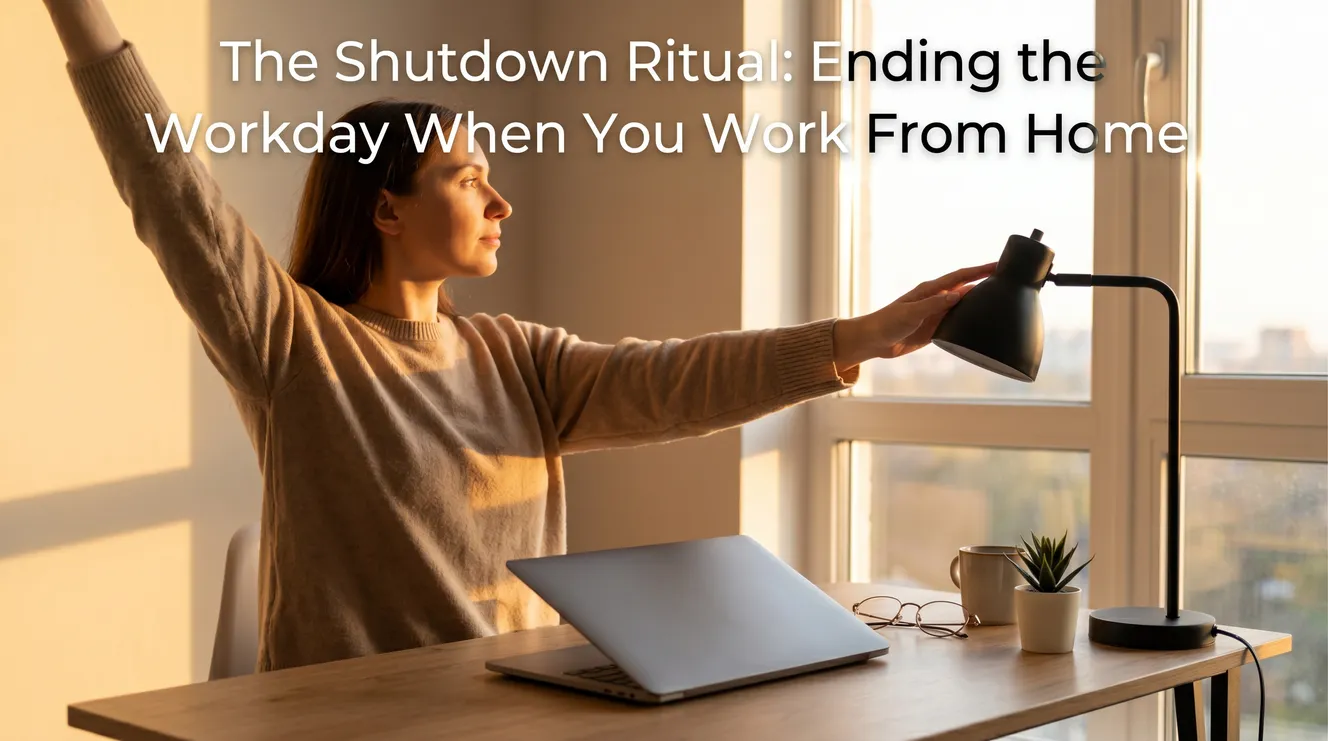
The “Shutdown Ritual”: Ending the Workday When You Work From Home
The commute was never just transportation. It was a transition—a physical and psychological airlock that separated the person who answered emails from the person who made dinner. When that commute shrinks from thirty minutes to thirty steps, the transition disappears. Your brain never receives the signal that work is finished, which means it stays in a state of low-grade vigilance indefinitely. Neuroscience-informed analysis explains that without clear transition time, the brain remains in a sympathetic fight-or-flight state, with stress responses lingering during family dinner, before bed, and across the weekend. The shutdown ritual exists to manufacture the exit that your home office has stolen.
This is not about time management. It is about cognitive hygiene. Psychological research frames the shutdown ritual as a brief, intentional set of tasks performed at the end of the workday to ensure incomplete items are captured and planned for, creating a clear boundary that signals to the brain it is safe to disconnect. When done consistently, it prevents the rumination that turns evenings into extensions of the workday and mornings into anxiety about what was forgotten. When skipped, the unfinished loops float freely through your personal time, hijacking your attention with the quiet certainty that you have left something undone.
The Invisible Office: Why Working From Home Erases the Exit
At the office, the exit is architectural. You pack your bag, walk through the lobby, join the stream of people heading toward transit or parking. The environment tells you the day is over. At home, the cues are missing or inverted. The same chair you used for a 3:00 PM Zoom call is the chair you are sitting in at 7:00 PM while scrolling through a spreadsheet. The same screen that displayed your calendar now displays Netflix, but the browser tab with your inbox is still open, glowing with unread counts. Remote work research identifies this as one of the primary challenges of distributed work: without physical separation, the mental distinction between professional and personal time collapses.
The technology exacerbates the blur. Being reachable via Slack, email, text, and multiple applications on different devices makes it difficult to establish when you are truly not at work. Boundary-setting research notes that the constant ping of notifications takes a psychological toll; it requires mental effort to ignore them, and doing so generates anxiety. Meanwhile, the weight of unfinished work continues to nag after 5:00 PM, tempting you to open the laptop “just for a minute” that becomes an hour. The home office is not a room. It is a state of mind that never powers down.
The Zeigarnik Effect: Why Your Brain Refuses to Clock Out
The primary enemy of the evening is not your boss. It is your own neurology. The Zeigarnik effect, first documented by psychologist Bluma Zeigarnik in the 1920s, describes the brain’s tendency to remember unfinished tasks more vividly than completed ones. Productivity research explains that our brains are hard-wired to keep us thinking about uncompleted tasks until we have completed them, functioning like a native reminder app that never stops pinging. This is useful for motivation during the day. It is catastrophic for rest at night.
The shutdown ritual defeats the Zeigarnik effect not by finishing everything—impossible in any meaningful job—but by capturing everything. When you write down the unfinished task and assign it a specific time tomorrow, your brain receives the same closure signal as if you had completed it. Studies confirm that simply writing out a plan to finish uncompleted tasks provides the same mental relief as actually completing the task. The ritual is a cheat code. It tells your brain, “This is handled. You do not need to hold it in working memory overnight.” Without that offload, the tasks circulate, degrading sleep quality and ensuring you wake up already tired.
The Ritual Architecture: A 10-Minute Closing Shift
The shutdown ritual is not a spa experience. It is a sequence of mechanical and psychological steps that should take between five and fifteen minutes. Workplace wellness research frames it as a bridge between “work” and “everything else,” a short, repeatable set of steps that tells your nervous system you are off duty. The following four steps are the minimum viable ritual. Skip any one of them, and the exit door remains ajar.
Step One: Capture All Open Loops
Do a rapid sweep of every inbox, tab, notebook, and scrap of paper where tasks or ideas landed during the day. The mechanical goal is total loop closure : review all inboxes, notes, and communications to ensure every incomplete task or pending commitment is recorded in a trusted system for the next workday. You are not trying to finish everything. You are trying to ensure nothing lives only in your head. A task floating in working memory will ambush you at 11:00 PM. A task written on tomorrow’s list will wait politely until morning.
Step Two: Plan Tomorrow’s Top Three
From the captured list, identify the three most important tasks for the following day. Not ten. Three. Time-management research shows that having a small, prioritized list reduces morning stress and makes it easier to focus when you sit back down. Write them on a sticky note, in a notebook, or in your task manager—anywhere you will see them first thing. This step is critical because it gives your brain a plan. The Zeigarnik effect feeds on ambiguity. A specific task scheduled for 9:00 AM tomorrow is no longer an ambiguous threat. It is an appointment.
Step Three: Clean the Physical and Digital Workspace
Close every browser tab except the one you need for tomorrow’s first task, if applicable. Save every document. Clear the desk of coffee cups and scrap paper. Organizational research confirms that clutter and disorganization distract us from tasks and our accomplishments, while a digital and physical clean-up helps you feel more organized emotionally and cognitively. If your work computer is also your personal computer, this step is non-negotiable. An open inbox tab is an invitation to check email during Netflix. A closed laptop is a wall.
Step Four: The Termination Cue
The final action must be definitive. Close the laptop. Turn off the desk lamp. Say a phrase out loud: “Shutdown complete.” Cal Newport’s original formulation used the exact phrase “schedule shutdown, complete,” with a strict rule: after uttering it, any work-related worry that pops up is answered with the thought, “I said the termination phrase. I would not have said this phrase if I hadn’t checked over all of my tasks, my calendar, and my weekly plan and decided that everything was captured and I was on top of everything. Therefore, there is no need to worry.” This sounds absurd until you practice it. The phrase is a mental circuit breaker. It trains your brain to trust the system rather than rehearsing the anxieties.
The Minimum Viable Shutdown
Minute 1–3: Sweep inboxes and capture every open task or idea into a trusted list.
Minute 4–6: Select tomorrow’s top three priorities and write them where you will see them first.
Minute 7–9: Close tabs, save documents, clear the desk, and shut down the work device.
Minute 10: Perform the termination cue—phrase, light switch, laptop close, or walk out of the room.
The Simulated Commute: Moving From One Mode to Another
The ritual closes the mental loops. The transition moves the body. Because working from home removes the physical commute, you must manufacture a replacement. Neuroscience-backed guidance recommends creating a “commute cue” ritual to signal to the brain that work is starting or ending. Light a specific candle. Change clothes. Walk around the block. Turn on a playlist. It does not need to be long; it needs to be consistent.
The clothing change is particularly underrated. The outfit you wore during video calls carries the residual identity of “professional self.” Changing into something else—anything else—creates a tactile signal that the role has shifted. Boundary research supports this: establishing a dedicated physical space to work in and prohibiting yourself from working outside it helps create a mental distinction between work and personal life. If space is limited, the clothing becomes the boundary. The blazer is work. The hoodie is home. The brain learns to read the difference.
Exercise is the most effective transition activity. Psychological research recommends using exercise as a transition because difficult physical strain helps reset your body physiologically and your brain psychologically for non-work life. A twenty-minute walk immediately after the shutdown ritual clears attention residue and provides the spatial distance that your home office cannot. The walk does not need to be scenic. It needs to be not work.
The Traps That Break the Ritual
Even with the best intentions, the shutdown ritual fails when specific habits or workplace norms undermine it. These traps are common in remote work and require explicit countermeasures.
Trap One: The “Just One More Email” Exception
You complete the ritual. You close the laptop. Then you remember one message you did not send. You open the laptop “just for a minute.” Thirty minutes later, you are back in the inbox, the Slack threads, and the mental state of 2:00 PM. The 15-minute wind-down framework warns that this exception is the single biggest killer of the ritual. The rule must be absolute: after the termination cue, the laptop does not reopen until the next scheduled work block. If the email was truly urgent, it would have been urgent during the capture phase. It was not. It was just the Zeigarnik effect whispering.
Trap Two: Skipping the Ritual on “Light” Days
On days with only two meetings and a few emails, it feels unnecessary to perform a full shutdown. You just drift into the evening. This is a mistake. The ritual’s power comes from consistency, not from the volume of work it closes. Psychological research emphasizes that missing the ritual, particularly on hybrid or lighter days, results in a background hum of destabilization and anxiety. The brain does not distinguish between heavy workdays and light workdays when it comes to open loops. A small unfinished task generates the same Zeigarnik effect as a large one. Do the ritual every day, even if it takes three minutes.
Trap Three: The Phone Foyer Failure
You shut down the laptop, but your phone still buzzes with work notifications. You check it while making dinner. You answer a message while watching television. The laptop ritual was theater because the real work device never closed. Productivity research recommends the “Phone Foyer Method”: keeping the phone plugged in at a set location when you are home, creating physical friction that prevents the knee-jerk check whenever you feel anxious or bored. If the phone must stay with you, turn off all work notifications at the same moment you close the laptop. The ritual is not complete until the last portal is sealed.
Trap Four: The Guilt of Not Doing Enough
On days when the to-do list is longer at 5:00 PM than it was at 9:00 AM, the ritual feels like surrender. You tell yourself you do not deserve to shut down because you did not earn it. This is a moral framework applied to a logistical problem. Research on procrastination and self-compassion suggests that practicing self-compassion when you fall short helps you overcome procrastination in the future. The ritual is not a reward for productivity. It is a boundary that protects your capacity to be productive tomorrow. Skip it because you had a bad day, and tomorrow starts worse.
The “Off Duty” Reframe: Permission, Not Performance
The deepest resistance to the shutdown ritual is not logistical. It is emotional. Many remote workers, particularly those in high-performing or people-pleasing roles, feel that being always available is proof of value. Neuroscience-informed analysis notes that internalized pressure to perform, fear of disapproval, and dysregulated nervous systems can drive after-hours responsiveness, making boundary-setting feel like a personal failure rather than a professional necessity. The shutdown ritual asks you to believe that your worth is not measured by your inbox response time.
The reframe is simple but radical: off duty is not a state you earn. It is a state you claim. The ritual is the mechanism of that claim. When you capture the tasks, plan the tomorrow, clean the space, and speak the phrase, you are not organizing your work. You are organizing your permission to stop. Productivity experts who maintain strict shutdown rituals emphasize that this systematic approach has been instrumental in sustaining high output while rarely working past 5:30 PM. The output does not suffer. The person producing it simply survives longer.
Over time, the ritual creates what psychologists call psychological detachment: the ability to put work out of your mind when you are not working. Research has shown that detaching at the end of each workday improves mood, sleep, stress levels, and workplace attitudes. The ritual is not a luxury for the organized. It is maintenance for the human. Without it, the remote worker becomes a machine that never powers down, slowly degrading until the output collapses along with the person.
Close the Laptop. Close the Day.
Working from home was supposed to offer freedom. Instead, for many, it offered a life where the office never closes because the office is the kitchen table six feet from the sofa. The shutdown ritual is not a cute productivity hack. It is a very real way to tell your nervous system, “We are off duty now.” It takes ten minutes. It requires no app, no subscription, and no special equipment. Just a sweep of your open loops, a plan for tomorrow, a clean desk, and a phrase that marks the end.
The Zeigarnik effect will whisper that you forgot something. The ritual answers: it is captured. The inbox will glow with unread counts. The ritual answers: they will be handled at 9:00 AM. The guilt will say you did not do enough today. The ritual answers: today is closed, and tomorrow is prepared. You do not need to earn your evening. You simply need to close the door.
Say the phrase. Shut the laptop. Change the clothes. Walk around the block. Be off duty. The work will wait. It always does. But your evening will not. It is happening now, with or without your permission. The ritual simply ensures you are present for it.