The fitness industry has colonized walking. It has been rebranded as cardio, as step-counting, as a weight-management tool. This is not wrong, but it is narrow. When you treat walking as exercise, you bring the entire psychology of obligation with you: metrics, improvement, consistency, guilt. Miss a day and you have failed a regimen. Walk too slowly and you have wasted a workout. The hobby frame removes all of this. A hobby is optional, which means it is sustainable precisely because nobody is forcing you to do it. You do it because the activity itself generates its own reward: a surprising doorway, a conversation with a stranger, the specific silence of a neighborhood at dawn.
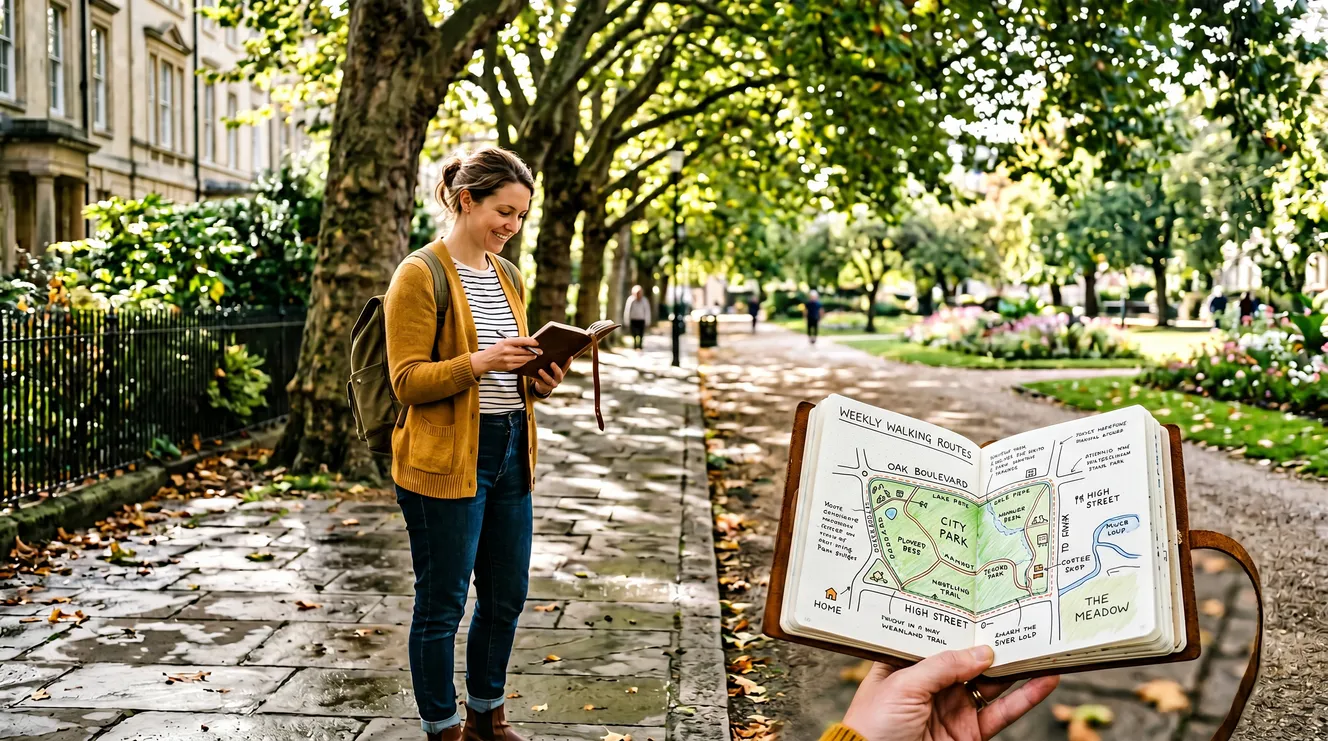
The route library is the infrastructure of this hobby. Instead of one default loop, you build a collection of walks—each with its own character, length, and mood. Monday might call for the industrial corridor with the mural you never noticed. Thursday might call for the cemetery with the old maples. Sunday might call for the waterfront path where the dogs are off-leash and the breeze carries salt. Researchers at UCLA have identified that hobbies can boost mental health and improve cognitive function by providing engagement and purpose outside of work. Walking as a hobby does not require a trainer, a gym membership, or a heart-rate monitor. It requires attention and a willingness to treat your own neighborhood as unexplored territory.
The Hobby Reframe: Why “Exercise” Kills the Walk
Exercise is an output-oriented activity. You run to improve your time. You lift to increase your weight. The goal is external and measurable, which means the activity is always being judged against a standard. Walking suffers under this framework because it is too gentle to feel like a proper workout and too slow to generate dramatic metrics. The step counter tries to fix this by gamifying volume, but gamification is still obligation with confetti.
A hobby is process-oriented. You knit because the rhythm is calming, not because you need a sweater. You garden because dirt under your fingernails feels honest, not because you are farming. Walking as a hobby follows the same logic. The goal is not to reach 10,000 steps. The goal is to notice that the bakery on Fourth Street changed its awning, or that the magnolia tree on Elm is three weeks ahead of schedule this year. The University of Georgia study emphasized that leisure-time physical activity correlates with better mental health outcomes precisely because the context is chosen rather than imposed. Walking to work because you must is not the same as walking to a bench because you want to sit on it.
The reframe also changes your relationship with speed. Exercise walking often demands a brisk pace, which turns the environment into a blur. Hobby walking allows dawdling. You can stop to read a historical plaque. You can backtrack to confirm that the cat you saw was actually orange, not cream. You can step into a shop you have passed a hundred times and never entered. These are not distractions from the workout. They are the point of the hobby.
The Route Library: A Collection, Not a Routine
A routine is a single path repeated until it becomes invisible. A library is a shelf of options, each chosen for a specific mood or need. Building one takes a few weeks of intentional exploration, after which you have a permanent resource that makes the hobby self-sustaining.
The Observation Walk (20–30 Minutes)
This is the core route of the hobby. It is not about distance or pace. It is about looking. Choose a neighborhood you think you know and commit to noticing ten things you have never seen before. The architectural detail above a doorway. The specific breed of dog that lives behind the third fence. The way the light hits a particular window at 5:00 PM. The first few times, you will struggle to find ten. That is the point. You have been walking through your environment as a commuter, not as a witness. The observation walk retrains your eyes.
The Audio Walk (30–45 Minutes)
Some walks are for thinking. Others are for listening. The audio walk pairs a route with a specific podcast, album, or audiobook chapter. The key is to match the terrain to the content. A linear, uncomplicated path—an esplanade, a rail trail, a long residential avenue—works best because you do not need to navigate. Your attention splits cleanly between the audio and the rhythm of your steps. Over time, specific routes become linked to specific stories. You will forever associate the overpass on Maple with the chapter about shipwrecks. This is the hobby at its most immersive.
The Errand Walk (15–20 Minutes)
The most practical route in the library is the one that accomplishes something. Post office, pharmacy, library drop box, coffee refill. The errand walk proves that walking is not separate from life; it is a way of moving through life more slowly. The trick is to choose the slightly farther location. The pharmacy three blocks past the closer one. The café that requires a ten-minute stroll instead of a two-minute drive. The errand becomes the excuse for the walk, and the walk becomes the best part of the errand.
The Green Walk (Variable)
Every library needs a route with trees, water, or sky. This is the reset walk, the one you take when the walls feel close. It might be a park loop, a riverside path, a botanical garden, or a cemetery with old-growth canopy. Research from the University of Minnesota highlights that time spent walking in nature reduces stress and anxiety, with the eye movements involved in tracking the environment helping to suppress the amygdala’s stress response. You do not need a wilderness. A single tree-lined block that is quieter than the rest of your neighborhood is enough.
The Social Walk (45–60 Minutes)
Walking is one of the few activities that accommodates conversation without demanding eye contact. The social route should be a loop that allows for pauses, disagreements about direction, and the natural rhythm of dialogue. Sidewalks are often too narrow for two people to walk abreast comfortably. Look for wide promenades, pedestrian malls, or park paths. The social walk turns a catch-up with a friend into a shared exploration rather than a static meal.
The Night Walk (20–30 Minutes)
The same streets are different after dark. The night walk requires safety—well-lit paths, familiar territory, appropriate footwear—but the reward is a completely altered sensory experience. The sounds change. The smells intensify. The architecture becomes silhouette rather than detail. The night walk is not for everyone or every neighborhood, but if your area supports it, it is the most dramatic route in the library. The world you thought you knew becomes foreign and quiet.
The Weekly Route Library Template
Monday: Observation Walk. Reset your attention for the week.
Tuesday: Errand Walk. Fold a necessary task into movement.
Wednesday: Audio Walk. Mid-week mental escape via headphones.
Thursday: Green Walk. Trees, water, or sky before the weekend rush.
Friday: Social Walk. Catch up with a friend while moving.
Saturday: Exploration Walk. A new street, a new neighborhood, a new discovery.
Sunday: Night Walk or Rest. Optional, atmospheric, or skipped without guilt.
How to Build Your Library From Scratch
You do not need to plan all seven routes at once. Start with three. The observation walk, the errand walk, and one other that matches your immediate environment. Test each one twice. The first time is reconnaissance. The second time is confirmation. By the third walk, you will know whether the route earns a permanent spot in the library.
Document lightly. A note on your phone with the street names, the approximate duration, and one sensory detail. “Oak to Maple, 25 minutes, bakery smell at the corner.” This is not a fitness log. It is a travel journal for your own city. Over months, the list grows. You begin to associate specific routes with specific needs. Stressed? The green walk. Bored? The exploration walk. Need to think? The audio walk. The library becomes a menu of emotional states, and you order accordingly.
Rotate aggressively. The fastest way to kill a hobby is repetition. If you walk the same route three times in one week, it becomes a commute. The library exists to prevent this. Even if you love a particular path, limit it to once a week. The scarcity preserves the novelty. The novelty preserves the attention. And the attention is what makes walking a hobby rather than a chore.
The Traps That Turn a Hobby Back Into Exercise
Even with the hobby frame, old habits creep in. These are the specific traps that convert a route library back into a training regimen.
Trap One: The Step Counter Compromise
You tell yourself you will track steps “just to see.” Within a week, the number becomes the goal. You choose the longer route not because it is interesting, but because it hits a round number. You feel disappointed on days with low counts even though the walk itself was beautiful. Research on exercise context confirms that the meaning and setting surrounding activity determine its impact on well-being. A quantified walk is not necessarily a meaningful one. Leave the tracker at home for at least half your routes.
Trap Two: Pace Creep
You begin to notice that you can walk the observation loop faster than last month. You start pushing the pace on the green walk. You turn the social walk into a power walk and your friend is breathless. Pace creep is the hobby’s silent killer. It transforms noticing into passing by. If you want to walk fast, designate one route as the brisk walk and keep the others slow. Speed is a valid preference, but it is not the default setting of the hobby.
Trap Three: The All-or-Nothing Library
You decide you need seven perfect routes before you can begin. You spend a weekend driving around scouting locations, take notes, and create a spreadsheet. Then you feel overwhelmed by your own system and abandon it. The library should grow organically. One route per week for two months is enough. The hobby is walking, not urban planning. Start with what is outside your door and expand in concentric circles.
Trap Four: Weather Dependence
If you only walk in ideal conditions, you have an exercise habit, not a hobby. Hobbyists do their thing in suboptimal circumstances because the activity itself is the reward. The rain walk is often the best route in the library. The cold walk clears your head faster than the warm one. Buy a decent jacket and appropriate shoes, then walk in weather that would make a fitness app send you a rest day notification. The all-weather walker is the committed hobbyist.
The Long Game: When Routes Become Memories
After a year of hobby walking, something shifts. The routes are no longer just paths. They are a timeline. You remember the April walk when the cherry blossoms were late. The July walk when the construction noise was unbearable. The October walk when you finally understood why that corner building has a turret. The library has become a diary written in footsteps.
This is the deepest reward of the hobby. Exercise is consumed and forgotten. A hobby accumulates. The route library gives you a sense of place that no gym membership can replicate. You know your city block by block, season by season, mood by mood. You have a relationship with the physical environment that is personal, specific, and entirely yours.
And because it is a hobby, not a regimen, there is no failure state. Miss a week and the routes wait patiently. Skip the night walk because you are tired and no metric punishes you. The library is always there, ready when you are, demanding nothing. That is the freedom of a hobby. It serves you. You do not serve it.
Walk Because You Are Curious, Not Because You Are Behind
The step counter will tell you that you need more. The fitness industry will tell you that walking is not enough. The hobbyist knows better. Walking is enough when it is done with attention, with variety, and with the freedom to stop and look at something that catches your eye. The route library is your defense against the commodification of movement. It is a personal collection of experiences that no app can measure and no trainer can prescribe.
Start with one new route this week. Notice five things. Write one sentence about it. That is the entire system. No metrics. No goals. No guilt. Just a person walking through their own life, slowly enough to see it. The hobby does not ask you to be faster, stronger, or more disciplined. It simply asks you to show up, look around, and take the long way home.
That is enough. That is the point.