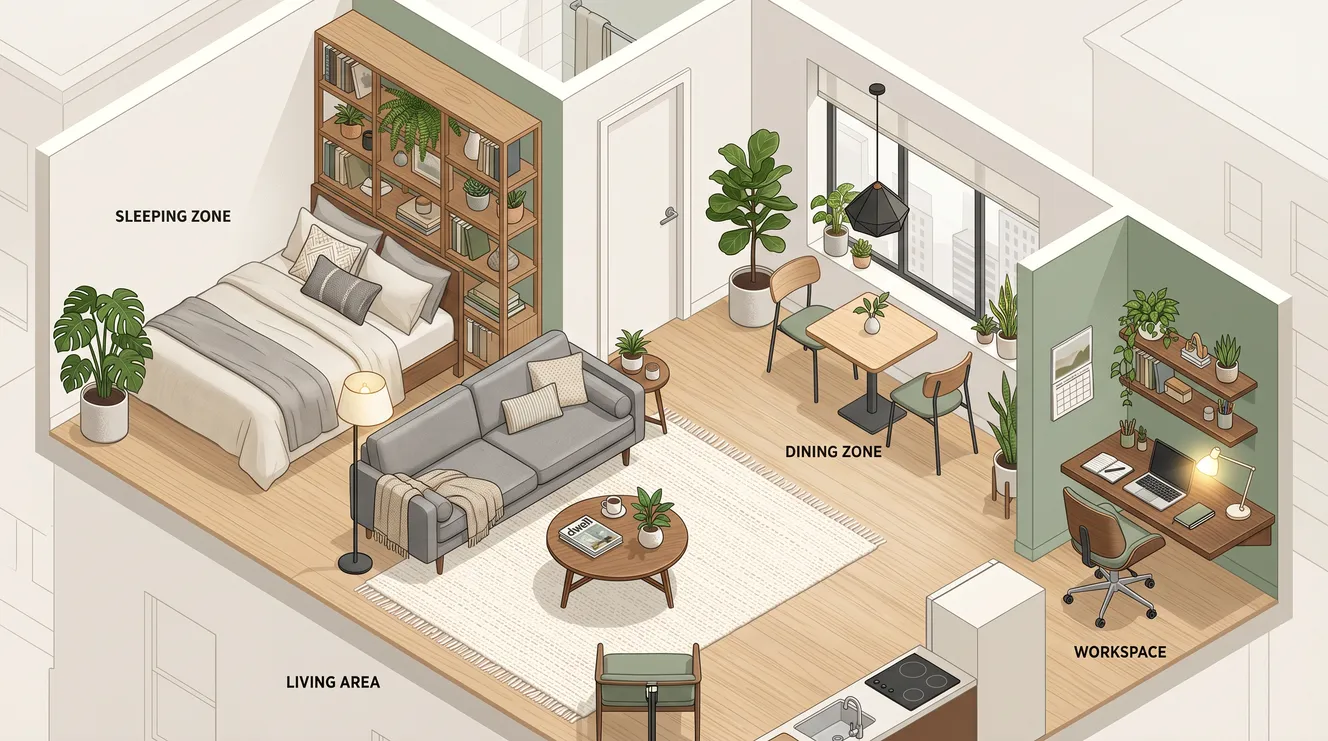
The studio apartment is a design paradox. It promises efficiency but often delivers spatial fatigue. Without the architectural cues that separate function—doorways, hallways, transitions—your nervous system treats the entire footprint as one undifferentiated arena of obligation. The laptop on the kitchen table becomes a workspace, a dining surface, and a nightstand simultaneously. The bed, visible from every angle, stops feeling like a sanctuary and starts feeling like an exhibit. This is not a storage problem. It is a zoning problem.
Traditional advice tells studio dwellers to buy less, fold more, and accept minimalism as penance for their square footage. That advice misses the point. The issue is not that you own a sofa. The issue is that your sofa has no territory. It floats in a room that refuses to assign it a role. The zones method corrects this by creating what designers call “invisible architecture”—boundaries that exist in perception rather than in drywall. Interior design research confirms that the key to mastering studio living lies in creating distinct zones for different activities within a single, unified space. The result is not a smaller home. It is a home that feels larger because it finally has rooms.
Why Open Concept Fails the Human Brain
Humans are territorial animals. We evolved in environments where physical boundaries signaled safety, function, and transition. A doorway is not just a passage; it is a psychological reset button. When you cross a threshold, your brain shifts context. The studio removes that mechanism. Your prefrontal cortex never receives the signal that work has ended and rest has begun, which is why so many studio dwellers report feeling “always on” despite having physically left their desk.
This constant context-switching within the same visual field creates what environmental psychologists call spatial blur. Your brain attempts to maintain multiple behavioral scripts—sleep, productivity, socializing, hygiene—in the same coordinates. The cognitive load is subtle but cumulative. By evening, you are not tired from your tasks. You are tired from the mental effort of pretending your bed is not also your office. Zoning interrupts this loop by introducing artificial thresholds. They do not need to be physical walls. They simply need to be legible enough that your brain reads them as borders.
The Four Layers of Invisible Architecture
The zones method operates through four layers that stack together like filters. Each layer can function alone, but combined they create a convincing illusion of separation. The layers are: Ground, Furniture, Light, and Vertical. Mastering them turns a studio from a warehouse of functions into a navigable home.
Layer One: Ground Markers
The floor is the most underutilized zoning tool in small-space living. An area rug under your sofa and coffee table does not just add warmth; it draws a line. Design experts emphasize that rugs and flooring changes can carve out a living room or sleeping area in one shot, instantly marking a lounge zone or sleeping nook. The brain processes the shift in texture or color as a territorial boundary.
The technique is simple but specific. Each major function in your studio should have its own ground plane. The living area gets a large, low-pile rug. The sleeping area gets a softer, higher-pile runner or a distinct mat. The dining area, even if it is just a small table, gets its own defined zone through a different material or shape. If you cannot afford multiple rugs, use what you have: a bath mat repurposed as a bedside landing zone, a woven throw under a reading chair, or even a painted floor cloth. The goal is differentiation, not decoration.
Layer Two: Furniture as Walls
Once the ground is marked, furniture completes the enclosure. The most effective studio divider is not a screen or a curtain. It is a sofa placed with its back to the bed. Furniture placement research shows that positioning a sofa with its back facing the kitchen or sleeping area naturally separates the living area while offering comfort and style. The back of a couch is a psychological barrier. It signals that what happens behind it belongs to a different realm.
Bookshelves take this further. An open-backed shelving unit placed perpendicular to a wall creates a partial partition that maintains airflow and sightlines while defining territory. Designers recommend the “Rule of Thirds”: one-third books, one-third objects, one-third empty space. This prevents the shelf from becoming a solid wall of clutter while still reading as a boundary. Console tables, sideboards, and even a strategically placed wardrobe can perform the same function. The key is to stop pushing every piece of furniture against the perimeter. Floating a piece into the room is what creates the zone.
Layer Three: Light as a Divider
Lighting is the most sophisticated zoning layer because it operates subconsciously. A single overhead fixture flattens a studio into one uniform field. Multiple light sources at varying heights and temperatures create depth and hierarchy. Lighting design principles confirm that a pendant or chandelier hung over a table draws the eye to that spot, signaling “here is the dining area,” while floor lamps or table lamps around a seating group cozy up the living zone.
The temperature of the light matters as much as the placement. Warm light (2700K to 3000K) signals relaxation and belongs in the sleeping and living zones. Cool light (4000K to 5000K) signals alertness and belongs in the work zone. By assigning a specific temperature to each function, you create an invisible schedule. When the warm lamp beside the sofa turns on, your body begins to downshift. When the cool desk lamp illuminates, your focus narrows. The studio stops being one room with one mood. It becomes a room with many moods, activated by switches.
Layer Four: Vertical Soft Partitions
When you need stronger separation but cannot build a wall, vertical elements provide the final layer of the illusion. These include curtains, plants, folding screens, and slatted panels. They add height and structure while preserving the openness that makes studios feel spacious. 2025 design trends highlight ceiling-mounted curtains, wooden slat partitions, and biophilic plant dividers as the leading flexible solutions for renters.
A tension rod installed between two walls can hold floor-to-ceiling drapes that close off the sleeping area at night and retract completely during the day. A tall plant stand with snake plants and pothos creates a living wall that absorbs sound and softens sightlines. A folding screen or macramé hanging adds texture and can be moved in minutes when the layout needs to shift. Apartment Therapy documented renters using clothing racks, shutters, and even repurposed window frames as temporary partitions. The vertical layer is where creativity matters most, because it is the layer that most closely mimics an actual wall without requiring a permit.
The Zone Audit: Four Questions Before You Rearrange
Where does the sun hit? Place your work zone near natural light and your sleep zone away from morning glare.
What do you see from your bed? If the answer is “everything,” your sleep quality is paying the price. Create a visual barrier.
Where does food happen? Eating at your desk trains your brain to associate work with meals. Define a dining zone, even if it is just a stool at a counter.
Where do you land when you enter? Every studio needs a transition zone. A small console or hook by the door prevents the entire apartment from becoming a dumping ground.
The Four Mandatory Zones (Even in 300 Square Feet)
Not every studio can accommodate a dining room, an office, a living room, and a bedroom. But every studio must accommodate four psychological zones: Sleep, Work, Living, and Transition. These are not luxuries. They are the minimum viable architecture for mental health. Missing any one of them creates a leak where stress accumulates.
The Sleep Zone: The Non-Negotiable Sanctuary
If you do nothing else, protect the sleep zone. This is the area where your bed lives, and it must be visually separated from the rest of the apartment. The bed should not be the first thing you see when you walk in. It should not be visible from the desk. It should not double as a sofa for guests. The sleep zone requires the strongest vertical partition you can manage—curtains, a folding screen, or a tall bookshelf—because sleep quality depends on the brain’s ability to forget that work and social obligations are three feet away.
The Work Zone: The Focus Enclave
The work zone does not need to be large. It needs to be consistent. A small desk facing a wall, rather than the room, creates a sense of enclosure. The ground marker here is critical: a small rug under the chair, a desk lamp with cool light, and a single vertical element like a pinboard or floating shelf behind the monitor. When you sit here, the rest of the studio should fall out of focus. When you leave, the work zone should be possible to ignore. The “cloffice” trend—using a closet or corner as a micro-office with a divider—proves that even three square feet can become a focused zone if the boundaries are legible.
The Living Zone: The Permission to Do Nothing
The living zone is where you consume rather than produce. Television, reading, conversation, or simply staring at a wall. This zone must feel distinct from the work zone or it becomes contaminated by productivity guilt. A sofa facing away from the desk, a soft rug, warm light, and a side table for beverages are the components. The living zone is the antidote to the studio’s tendency to turn every moment into a task. It is the architectural equivalent of a deep breath.
The Transition Zone: The Airlock
The most overlooked zone in studio design is the transition area near the front door. Without it, the outside world enters immediately. Shoes, bags, mail, and the psychic residue of the street all land in the center of your living space. A transition zone can be as small as a single shelf, a hook, and a tray for keys. Its purpose is to catch the debris of daily life before it migrates to the sofa and the bed. In zoning terms, it is the airlock. It gives you a place to shed the day before entering your home.
The Traps That Destroy Studio Zoning
Even with the best intentions, studio zoning fails when certain habits or design choices undermine the boundaries. These traps are insidious because they masquerade as space-saving solutions.
Trap One: The Multifunctional Monolith
Murphy beds, sofa beds, and fold-down desks are brilliant in theory. In practice, they often erase the very zones they are meant to enable. A bed that folds into a wall destroys the sleep zone’s psychological stability. A desk that is also a dining table collapses work and leisure into the same coordinates. Use convertible furniture sparingly, and only for secondary zones. The sleep zone and work zone should be as permanent as your lease allows. If you must use a sofa bed, treat it as a bed first and a sofa second. The zone takes precedence over the furniture’s resume.
Trap Two: Over-Zonation
In the enthusiasm to create boundaries, some studio dwellers install too many dividers. A rug here, a screen there, a curtain everywhere, and suddenly the apartment feels like a flea market of competing territories. Designers caution that materials should let at least 20% of light through if the apartment only has one window. Solid partitions that block the sole window or create labyrinthine pathways make a small space feel smaller. The zones method is about suggestion, not obstruction.
Trap Three: The Perimeter Push
Every furniture arrangement guide for small spaces tells you to push everything against the walls to maximize floor area. This advice is catastrophic for zoning. When all furniture hugs the perimeter, the center of the room becomes a dead zone and the edges become a cluttered ring. Floating pieces into the room—placing the sofa in the middle, positioning the desk perpendicular to a wall—is what creates the islands of function that read as separate rooms. You will lose a few square feet of walking space. You will gain an apartment that feels designed rather than stored.
The 48-Hour Zone Test
After implementing the zones method, test it over two full days. Do not rearrange further. Simply observe. Can you sit in the living zone without seeing the bed? Can you work at the desk without feeling like you are still in bed? Do you sleep better when the sleep zone is visually sealed? Does the transition zone actually catch your belongings, or do they still migrate inward?
The test reveals what blueprints cannot. Some studios have structural quirks—a support beam, a radiator, a window in the wrong place—that make certain zones impossible in their ideal form. Adaptation is part of the method. A sleep zone might need to be a lofted bed with a curtain underneath. A work zone might need to live in a closet with the door removed. The zones method is not prescriptive about shape. It is prescriptive about separation. If the separation works, the zone works.
The Studio Manifesto
One room does not mean one purpose. Open floor plans require more intention, not less.
Furniture against walls is storage, not design. Float pieces to create boundaries and flow.
Light is a wall. Different temperatures and heights create rooms where drywall cannot.
Your bed is not a sofa. Protect the sleep zone as if your health depends on it—because it does.
The Apartment That Finally Has Rooms
The studio apartment is not a design failure waiting to be solved by a bigger paycheck. It is a puzzle that rewards attention. The zones method does not demand renovation, demolition, or a furniture budget. It demands that you stop treating your home like a single warehouse and start treating it like a village of small, distinct neighborhoods. Each with its own ground. Each with its own light. Each with its own permission.
When you lie down at night and cannot see your desk, you will sleep differently. When you sit at that desk and cannot see your bed, you will focus differently. When you walk through your front door and pause at the transition shelf before entering the living zone, you will feel differently. The architecture is invisible. The effect is not.
Start with the rug. Float the sofa. Hang the curtain. Light the lamp. Your studio is already larger than you think. You just need to teach your eyes where the walls are.