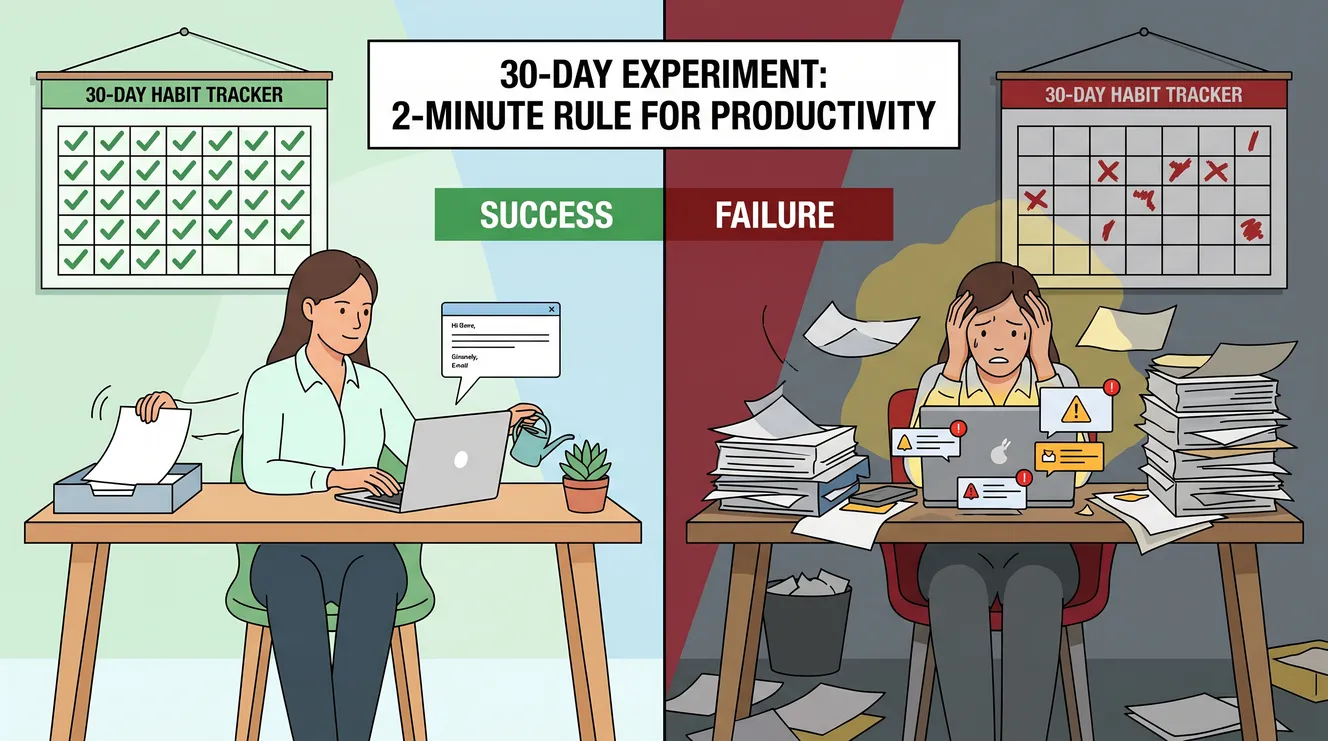
The 2-minute rule has two distinct parents, and most people conflate them. David Allen, in his Getting Things Done methodology , created the original version: if you determine an action can be done in two minutes, you actually should do it right then because it will take longer to organize and review it than to finish it the first time you notice it. This is an efficiency argument about task management. James Clear, in Atomic Habits , adapted it into a behavioral argument: every goal can be started in two minutes or less, and the first two minutes are a ritual to master the habit of showing up. One rule is about clearing inputs. The other is about starting behaviors. Thirty days of testing both reveals that they succeed and fail in entirely different domains.
This article is the field report. No theory. No cheerleading. Just four weeks of applying the rule as written, observing where life improved and where it quietly derailed, and the modified framework that emerged from the wreckage. If you are considering the 2-minute rule as your next productivity system, read this before you set the timer.
Week 1: The Clearing
The first seven days are pure dopamine. You attack the low-hanging fruit that has been colonizing your countertops and inbox for months. The coffee mug rinsed immediately after use. The Slack message answered before it becomes a thread. The Amazon return initiated while the box is still in your hand. One writer who tested the rule documented that after a week of applying it to her inbox, the feeling of overwhelm became less intense and she actually replied to several emails throughout the day. The physical environment responds fastest. Dishes do not pile up. Laundry does not achieve sentience. The desk stays clear because every piece of paper is filed, scanned, or trashed on arrival.
This phase feels like a superpower because it is. The original GTD version of the rule was designed for exactly this: eliminating the administrative scum that floats on top of a busy life. David Allen emphasizes that the efficiency factor is real—it would take you less than two minutes to do the task, but longer than two minutes to look at it again and review it later. During Week 1, you prove him right. The sink is empty. The inbox is manageable. The to-do list is shorter than it has been in years. You are tempted to declare victory and write a testimonial.
But Week 1 also introduces the first hairline fracture. You begin to notice that every two-minute task arrives as an interruption. You sit down to write, remember the lightbulb in the hallway, and spend ninety seconds replacing it. You return to the desk, get one sentence down, and notice a text that requires a thirty-second reply. The reply leads to a three-minute exchange. By the time you look up, the writing session is dead. The rule kept your house clean. It also kept your brain in a permanent state of partial attention.
Week 2: The Interruption Tax
By day ten, the context-switching cost becomes undeniable. You are not completing more work. You are completing more tasks, which is not the same thing. A task is a unit of administration. Work is a unit of creation. The 2-minute rule excels at the former and silently assassinates the latter. Productivity author Laura Vanderkam identified this flaw precisely , noting that going off to do 2-minute tasks whenever you think of them is a recipe for getting very little of substance done. Her alternative is batching: a designated window for small tasks, which keeps them from taking over the rest of your schedule.
The tax is neurological, not just logistical. Every time you switch from a deep task to a shallow one, your brain pays a re-entry fee. It takes an average of twenty-three minutes to return to deep focus after an interruption. The 2-minute task itself is brief. The recovery from it is not. By midweek, you realize that your most productive hours have been shredded into ten-minute fragments, each separated by a micro-errand that felt responsible but functioned as an exit ramp from flow.
There is also the time-estimation problem. Vanderkam notes that humans are terrible at time estimation . A task that looks like two minutes—texting someone about a program, updating an address, filing a form—often spirals into a phone call, a login reset, or a follow-up email chain. The rule assumes you can accurately gauge the duration before you begin. In practice, you cannot. The two-minute task becomes the ten-minute detour, and your schedule was not built for detours.
Week 3: The Procrastination Engine
Week three is where the rule reveals its darkest side. You begin using two-minute tasks to avoid the projects that actually matter. The presentation that requires three hours of research? Suddenly, organizing the spice rack feels urgent. The chapter that needs rewriting? The inbox is calling, and every email is a noble two-minute mission. One writer described this trap as a lack of vision: when you have a clear image of where you are going and why, you will not flit from one low-priority task to the next. Without that vision, the 2-minute rule becomes a shield against meaningful work.
The psychological mechanism is elegant and brutal. Hard projects generate anxiety. Two-minute tasks generate completion. Your brain learns to chase the dopamine of finishing over the discomfort of starting. By day eighteen, you have the cleanest apartment and the emptiest inbox of your life, coupled with the gnawing sense that your actual career is stalled. Online productivity communities have documented this exact collapse , with users reporting that the rule destroyed their productivity by fragmenting their attention into micro-tasks that felt productive while sabotaging deep work.
The habit-formation version of the rule suffers here too. James Clear argues that the point is not to do one thing but to master the habit of showing up. The first two minutes become a ritual at the beginning of a larger routine. This is genuinely brilliant for exercise, writing, and meditation. But it does not help when the two-minute task is administrative rather than behavioral. Answering an email is not a ritual that leads to a larger creative routine. It is a dead end disguised as a doorway.
Week 4: The Selective Filter
By the final week, survival requires editing. You cannot apply the rule to everything. You must apply it to the right things at the right times. The thirty-day test becomes a sorting process: which tasks actually benefit from immediate execution, and which ones are simply using the rule as a Trojan horse for interruption?
What survives the filter is physical and environmental. The dish in the sink. The shoe by the door. The coffee grounds in the filter. These tasks resist batching because they occupy shared space; leaving them creates visual clutter that degrades focus. The Apartment Therapy test confirmed that applying the rule to household maintenance prevented pile-ups and eliminated the need for big cleaning days. This is the rule at its best: front-loading trivial labor so it never compounds.
What dies in the filter is digital and administrative. Email, Slack, text messages, form submissions, and online errands all get batched into a single afternoon window. The cost of switching between digital contexts is too high, and the risk of expansion—two minutes becoming ten—is too great. Vanderkam’s Friday Punch List becomes the replacement: a dedicated block where twenty small tasks are executed in sequence, creating momentum without destroying the mornings that should be reserved for deep work.
The Three Zones Where the Rule Actually Works
After thirty days, three categories emerge as genuine beneficiaries of immediate execution. These are not theoretical. They are the tasks that, when delayed, create disproportionate drag relative to their size.
Zone One: Physical Environment Maintenance
Anything that occupies shared physical space and takes less than two minutes should be done immediately. Dishes, laundry transfer, wiping a counter, hanging a coat, taking out trash. The reason is spatial: these items are visible, and visibility creates cognitive load. A single dish in the sink is not a problem. The knowledge that the sink is now a dish-accumulation zone is a problem. The 2-minute rule keeps the environment in a default state of order, which reduces the background anxiety that untidy spaces generate. This is the original GTD rule at its most effective.
Zone Two: Health Micro-Habits
The James Clear version of the rule shines here. Clear’s philosophy is that a habit must be established before it can be improved, and if you cannot learn the basic skill of showing up, you have little hope of mastering the finer details. Two minutes of kettlebell swings, two minutes of stretching, two minutes of journaling—these are not the workout or the practice. They are the gateway. One tester found that by the end of a week, she had completed at least fifty kettlebell swings and several short breaks to stand up and move around. The micro-habit accumulated into macro-results because the barrier to entry was negligible.
Zone Three: Genuine Quick Comms
Some communication really is two minutes and genuinely benefits from immediacy. A confirmation text. A calendar acceptance. A “received, will review by Friday” acknowledgment. These are social lubricants that prevent follow-up pings and status-check emails. The filter is strict: if the reply requires no decision-making, no research, and no emotional labor, do it now. If it requires any of those, it enters the batch. The rule works when the task is truly closed-ended. It fails when the two-minute reply is actually the first move in a longer chess game.
The Three Traps Where the Rule Destroys You
Equally important are the domains where the thirty-day test proved the rule actively harmful. Avoiding these traps is more valuable than exploiting the successes.
Trap One: The Deep Work Interruption
Never apply the 2-minute rule during a focus block. Never. The cost of leaving a deep task to replace a lightbulb or answer a text is not two minutes. It is the twenty-three-minute recovery window, plus the risk that you will never return to the original task at all. The Produclavity analysis warned that there is no end to the number of attractive tasks that seem useful and can be done in two minutes or less, leading to flitting from one to the next without ever doing deep work. During focus hours, the rule is not a productivity tool. It is a sabotage device.
Trap Two: The Administrative Multiplication
For people managing households, children, or complex administrative lives, the rule is a trap disguised as a gift. Vanderkam observed that those with a lot of small things on their plate have to be careful or they will literally consume their entire lives. Permission slips, camp forms, medical appointments, school communications—these are rarely true two-minute tasks, and even when they are, they arrive in such volume that immediate execution becomes a full-time job. Batching is not laziness here. It is survival.
Trap Three: The Emotional Labor Disguise
Some tasks are technically two minutes but emotionally expensive. A text to a grieving friend. A reply to a difficult colleague. A decision about a boundary. The rule says do it now, but emotional labor does not obey the clock. Rushing these interactions to clear the inbox often produces worse outcomes than delaying them for reflection. The 2-minute rule assumes all tasks are mechanical. Emotional tasks are chemical. They require pacing, and the rule has no respect for pacing.
The Modified Rule: What Thirty Days Actually Teaches
The 2-minute rule is not a religion. It is a filter. After thirty days, the useful version looks like this: if the task is physical, environmental, or a health gateway habit, and if you are not currently in a focus block, do it immediately. Everything else gets written down and batched. The writing down is critical. David Allen’s original insight was not just about speed. It was about getting things out of your head so they do not occupy mental RAM. A two-minute task done immediately achieves this. A two-minute task captured on a list and done later achieves the same thing, without the context-switching tax.
The batch window is where the accumulated small tasks die. Twenty minutes at the end of the workday. A Friday afternoon punch list. A Sunday evening admin session. Vanderkam’s approach of doing twenty little things in a row creates a rhythm that the scattered execution of the 2-minute rule cannot match. You feel like a machine because you are in a single mode: administrative execution. The mode switching is what kills productivity, not the tasks themselves.
For habit formation, the modified rule is even simpler: the first two minutes are sacred, but they are also the whole thing. Clear’s most radical suggestion is to do the habit for two minutes and then stop. Go for a run, but you must stop after two minutes. Start meditating, but you must stop after two minutes. This removes the pressure to perform and replaces it with the pressure to show up. After thirty days, the showing up becomes automatic, and the stopping becomes optional. That is where the rule earns its reputation—not as a task management hack, but as a behavioral on-ramp.
The 30-Day Modified Protocol
During Focus Blocks: No 2-minute rule. Capture tasks on paper and resume deep work immediately.
During Open Time: Apply the rule only to physical/environmental tasks and closed-ended communications.
For New Habits: Two minutes is the entire commitment. Stop when the timer ends. Momentum is a bonus, not an obligation.
For Digital Admin: Batch everything into a single 20-minute window. Do not execute ad hoc.
The Rule Is a Scalpel, Not a Hammer
Thirty days of the 2-minute rule taught me that productivity advice is not wrong. It is just rarely universal. The rule works magnificently in specific domains and disastrously in others. Applied to your kitchen sink, it is a miracle. Applied to your inbox during a writing session, it is a menace. The mistake is treating it as a lifestyle rather than a technique. You would not use a hammer to cut a tomato. You should not use the 2-minute rule to manage your entire life.
What remains after the test is a selective filter. Physical tasks die immediately. Digital tasks get batched. Emotional tasks get scheduled. Deep work gets protected. And new habits get started with the smallest possible commitment, because the only thing harder than doing something hard is starting something hard. The first two minutes are not the whole journey. But they are the only part of the journey that cannot be skipped. Master the start. Batch the rest. And leave the shame of an unfinished to-do list for someone who has not yet learned that productivity is not about doing everything. It is about doing the right things at the right time.
Set the timer if you want. But know what the timer is for.