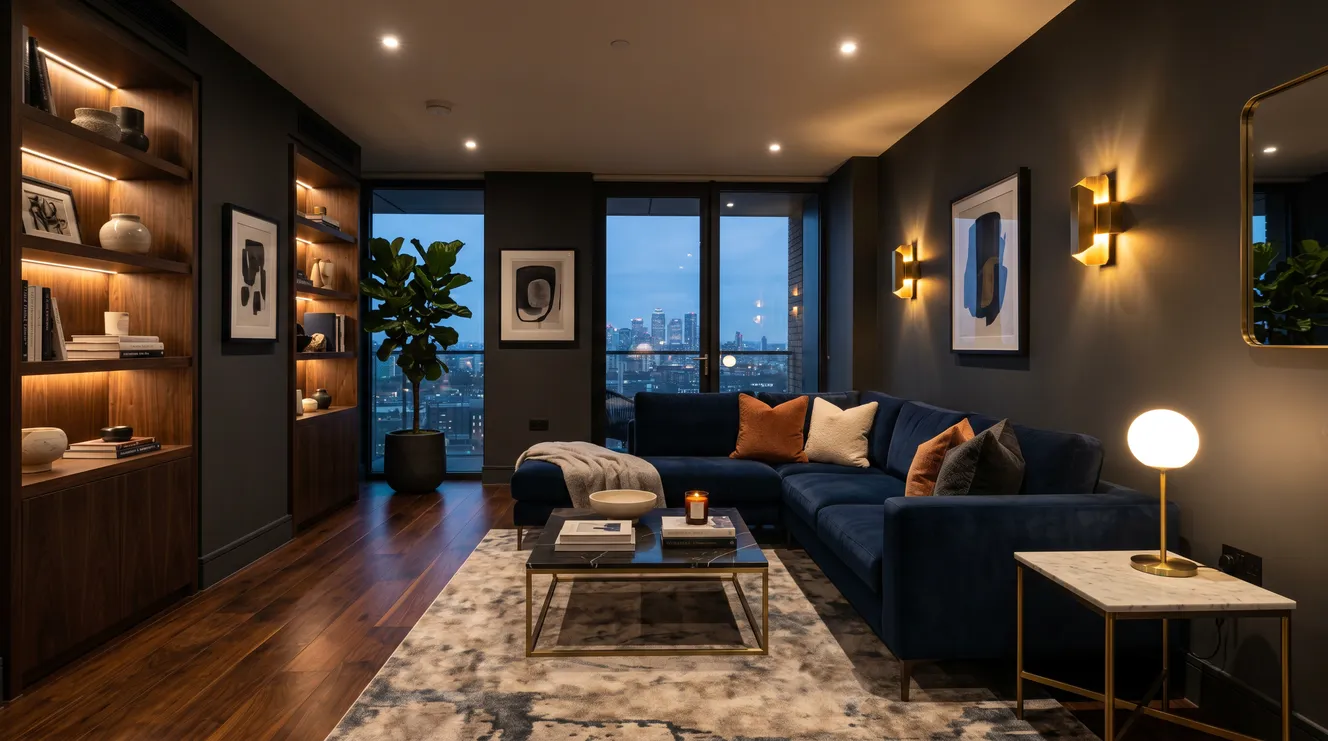
The floor lamp is the default purchase for a reason. It is portable, affordable, and requires no installation. But it is also a single point source blasting upward and outward from knee height, which creates harsh shadows above waist level and leaves ceilings feeling low and oppressive. In a dark apartment—especially one with north-facing windows, deep floor plans, or neighboring buildings that block the sky—relying on floor lamps is like trying to heat a house with space heaters. Warm in one spot, arctic everywhere else. Lighting design guides emphasize that one central ceiling light is never enough, especially in a small apartment where versatility is key. You need a system that illuminates vertically, horizontally, and atmospherically, all without requiring an electrician or violating your lease.
The layered approach treats light like paint. You do not slap one color on the wall and call it finished. You prime, you base-coat, you detail. The layers are ambient, task, accent, and atmospheric. Each has a distinct job, a distinct height, and a distinct color temperature. When combined, they transform a cave into a room that feels larger than its square footage and warmer than its rent. And because modern lighting technology has gone wireless, rechargeable, and adhesive, every layer below is achievable in a rental with zero hardwiring.
Why Floor Lamps Create the Illusion of Light Without the Reality
To understand why floor lamps fail, you need to understand how the eye reads a room. Human perception of brightness is driven by contrast and vertical illumination. A floor lamp sends most of its lumens across the middle band of the room—roughly two to five feet off the ground. Above that, shadows accumulate. The ceiling stays dark, which makes the walls feel closer and the room feel smaller. Below that, the floor is overlit, which wastes energy illuminating carpet.
The second problem is spectral. Most cheap floor lamps use a single bulb with a single color temperature, usually too warm for reading or too cool for relaxing. They cannot shift with the day. Research on circadian health confirms that light quality matters as much as light quantity; exposure to the wrong light at the wrong time disrupts melatonin, elevates heart rate during sleep, and impairs insulin sensitivity. A bright, cool floor lamp at 9:00 PM is not helping you wind down. It is telling your brain that noon has arrived.
Finally, floor lamps consume floor space. In a small apartment, every square foot is real estate. A lamp that requires a footprint of twelve inches in diameter plus clearance for the shade is a lamp that has just eliminated a storage opportunity or a traffic path. The layered approach moves light upward and outward, onto walls, ceilings, and undersurfaces, freeing the floor for actual living.
Layer One: Ambient Light—The Invisible Foundation
Ambient light is the base coat. It is not supposed to be noticed. It is supposed to eliminate the feeling of darkness without creating the feeling of a hospital corridor. Lighting guides define ambient light as the foundation layer that provides overall illumination for safe navigation. In a dark apartment, this layer is usually the most broken, because the existing overhead fixture is either too dim, too yellow, or positioned in the center of the room where it creates a spotlight effect and leaves corners in shadow.
The renter-friendly fix is to augment, not replace. If your overhead fixture accepts bulbs, install the brightest LED your socket allows, but diffuse it with a paper or linen shade rather than exposed glass. If the fixture is fixed and pathetic, ignore it and build a ceiling of light using plug-in pendant lights swagged from wall hooks. Interior designers recommend plug-in pendants with paper, frosted glass, or fabric shades because they diffuse light evenly across a wide radius. A single pendant hung over a coffee table or dining surface provides ambient uplight that bounces off the ceiling and returns as soft, room-filling glow.
For rooms with no overhead fixture at all—common in pre-war rentals—create a virtual ceiling with multiple height sources. A plug-in pendant in the center, a wall-mounted uplight in the corner, and LED strips atop a bookshelf all send light upward. The ceiling becomes a reflector, and the room gains volume it never had architecturally. The cost for this layer is $30 to $60, depending on how many pendants or strips you deploy.
Layer Two: Task Light—The Focused Beam
Task lighting is where most people overdo ambient and underdo precision. You do not need the entire kitchen to be brighter. You need the cutting board to be brighter. You do not need the entire living room to glow. You need the page of your book to glow. Task lights are narrow, directional, and positioned close to the work. Design resources recommend under-cabinet and under-shelf lighting for work areas, using slim LED strips or puck lights that remove shadows from countertops and offer task-friendly illumination.
The modern renter has options that require no wiring. Rechargeable puck lights with adhesive magnetic strips attach under kitchen cabinets and detach for charging. Apartment Therapy documented motion-sensing LED lights that install in minutes and illuminate automatically, ideal for closets, pantries, and under-sink cabinets. For desks and bedside tables, clip-on reading lamps with rechargeable batteries provide focused 4000K light that reduces eye strain without flooding the room.
The placement rule for task light is proximity, not power. A 300-lumen desk lamp positioned eighteen inches from a keyboard outperforms a 1500-lumen floor lamp across the room because the light arrives at the surface instead of dissipating through air. Task lighting should also be cooler in temperature—3500K to 4500K—to promote alertness and visual acuity. Warm light feels cozy but actually reduces contrast on printed text and digital screens, forcing your eyes to work harder.
Layer Three: Accent Light—The Sculptural Layer
Accent lighting is the layer most renters skip because it feels decorative rather than functional. This is a mistake. Accent lights create depth by illuminating vertical surfaces—walls, bookcases, artwork—which makes a room feel larger and more architecturally interesting. Small-space lighting discussions note that lighting corners is critical because small rooms always look boxy when everything is lit from the center. A little uplight or a lamp pointed diagonally into a corner breaks the box and adds dimension.
Battery-operated picture lights are an underutilized tool for dark apartments. Design experts recommend cordless picture lights to add a warm glow that draws the eye upward, which is critical in spaces with no overhead lighting. Even if you have no art, mount them above bookshelves or a gallery wall of framed prints. The light grazes the wall texture and creates shadow variation that reads as architectural detail.
LED strip lights tucked behind furniture—behind the headboard, under the sofa, along the back of a media console—provide low-level accent glow that lifts the furniture off the floor and makes the room feel airier. The key is concealment. If you can see the individual diodes, the effect is technical rather than atmospheric. Use diffused channels or place strips behind a lip of wood or fabric so the light escapes as a soft halo rather than a dotted line.
Layer Four: Atmospheric Light—The Emotional Dimmer
Atmospheric light has no functional job. It exists to make you feel something. In a dark apartment, this layer is essential because it compensates for the lack of natural warmth that sun-drenched rooms receive automatically. Candles, fairy lights, and small salt lamps fall into this category, but the most practical modern option is the smart bulb. Design guides champion smart LED bulbs as game-savers in compact apartments because you can change brightness, color temperature, and even hue through an app. Daylight brightness for working, warm soft glow for evening—all from the same fixture.
The atmospheric layer should be warm—2200K to 2700K—and low in intensity. It is the visual equivalent of a blanket. Place it where you relax, not where you work. A bedside table, a windowsill, a shelf above the kitchen cabinets. The goal is pockets of softness that give your eyes a place to rest. In a room lit only by cool, bright task and ambient sources, the nervous system stays in a state of low-grade alert. The atmospheric layer tells it that the day is ending and the space is safe.
The 3-Point Light Rule for Any Room
Point One (High): A ceiling or wall-mounted source that sends light upward or downward from above eye level. This establishes the room’s vertical volume.
Point Two (Mid): A task or table-level source directed at a specific surface—desk, counter, reading chair. This provides functional clarity.
Point Three (Low): An accent or atmospheric source below eye level—strips, candles, uplights. This grounds the room and adds emotional warmth.
The Mirror Strategy: Multiplying What You Have
In a dark apartment, a mirror is a light fixture that requires no electricity. Design resources emphasize that introducing mirrors or shiny surfaces increases lighting by reflecting natural and artificial light. A mirror opposite a window or lamp can double the effective lumens in a room. But placement must be intentional. A mirror facing a dark wall simply reflects darkness. A mirror facing a light source—whether a window, a pendant, or a bright piece of art—becomes a secondary emitter.
The most effective mirror placement is perpendicular to a window, not opposite it. When placed on a wall adjacent to the window, the mirror catches the sidelight and bounces it deeper into the room, illuminating areas that direct sunlight never reaches. For artificial light, place a mirror behind or beside a table lamp to create the illusion of a second lamp. The effect is not trickery; it is physics. Every photon that would have been absorbed by a wall is now redirected into the living space.
Color Temperature by Zone: A Renter’s Cheat Sheet
One of the most common mistakes in apartment lighting is using the same bulb temperature everywhere. The result is a flat, monochromatic space that feels either sterile or gloomy depending on the wattage. Different zones demand different temperatures because different activities require different levels of alertness.
For work zones—desks, kitchen prep areas, bathroom vanities—use cool white (3500K to 4500K). This temperature mimics midday sun and promotes concentration. For living zones—sofas, dining tables, bedrooms—use warm white (2700K to 3000K). This mimics late-afternoon sun and encourages relaxation. For atmospheric accents, use very warm amber (2200K to 2700K). This mimics candlelight and signals the brain to downshift.
Smart bulbs make this transition automatic. Set a schedule: cool and bright from 7:00 AM to 6:00 PM, warm and dim from 6:00 PM to 10:00 PM, and amber nightlight from 10:00 PM onward. Your apartment becomes a circadian instrument rather than a static cave. Research on sleep health underscores that even brief exposure to bright or cool light before bed delays melatonin secretion and disrupts deep sleep. The bulb you choose for your bedside lamp is not a detail. It is a biological intervention.
The Renter’s Wiring-Free Arsenal
The best lighting upgrades for renters share three traits: they require no hardwiring, they leave no damage, and they move with you. Lighting retailers now specialize in rechargeable wall lights, plug-in pendants, and portable solutions that need no electrician. The technology has matured to the point where battery-operated sconces can deliver ten hours of illumination on a single charge, and magnetic puck lights detach for USB recharging in an hour.
Plug-in pendants are the secret weapon of the dark rental. Swagged from a ceiling hook anchored into a wall stud or a heavy-duty adhesive hook rated for five pounds, they bring light to the center of a room without touching the junction box. Apartment upgrade guides highlight plug-in wall sconces for instant elegance and LED strip lights for modern flair, both achievable without tools. The cord is not a flaw to hide; it is a design element to integrate. Wrap it in fabric cord covers, run it along crown molding with adhesive clips, or let it hang in a deliberate loop. The goal is intentionality, not invisibility.
For closets, pantries, and under-sink cabinets—spaces that rental landlords typically leave in darkness—motion-sensing LED bars provide automatic illumination when doors open. Renter testimonials confirm that these stick-on lights are transformative for daily routines, turning dark storage into usable space. The installation is peel-and-stick. The removal is peel-and-go. The deposit is untouched.
Common Mistakes That Keep Apartments Dark
Even with the right equipment, execution errors can undermine the entire system. Avoid these specific traps.
Mistake One: The Overhead Blitz
Replacing a dim overhead bulb with a blindingly bright one does not fix darkness; it creates glare. A single 100-watt-equivalent LED in a small ceiling fixture casts harsh shadows under your eyes and furniture, making the room feel more cavernous, not less. Ambient light should be diffused, not concentrated. Use shades, multiple lower-wattage sources, or bounce light off ceilings rather than blasting it downward.
Mistake Two: Ignoring Vertical Surfaces
Dark walls absorb light. If your apartment has deep gray or navy paint, you need twice the lumen output to achieve the same brightness as a white room. The solution is not more power; it is strategic placement. Uplights that graze walls, picture lights that illuminate art, and shelf lighting that backlights objects all turn dark surfaces into luminous features. A lit wall is brighter than a white wall in shadow.
Mistake Three: Mismatched Color Temperatures
A room with a 2700K floor lamp, a 5000K desk lamp, and a 3000K overhead fixture feels chaotic. The eye constantly adjusts between warm and cool, creating subliminal fatigue. Choose a dominant temperature for each room and vary by no more than 500K between sources. The exception is the task layer, which can be cooler, but even then, keep it within a perceptible family.
Mistake Four: Forgetting the Corners
Corners are where darkness goes to die—and multiply. A room with lit center and dark corners feels smaller and gloomier than it is. Small-space discussions emphasize that a little uplight or a lamp pointed diagonally into a corner breaks the boxiness and adds perceived depth. A $15 floor uplight aimed at the ceiling corner can transform the entire proportions of a studio.
From Cave to Sanctuary
A dark apartment is not a personality trait. It is a solvable physics problem. The floor lamp was never going to be enough, not because it is poorly made, but because no single source can perform four distinct jobs simultaneously. You need the high ambient wash that pushes back the shadows. You need the focused task beam that lets you work without squinting. You need the accent graze that gives walls dimension. And you need the atmospheric glow that tells your nervous system it is safe to exhale.
The technology to achieve all four layers without an electrician now exists at every price point. Plug-in pendants, rechargeable sconces, adhesive LED strips, and smart bulbs have turned the rental apartment from a lighting prison into a lighting playground. You do not need to rewire. You need to rethink. Start with the ambient foundation. Add task precision where you work. Graze the walls with accent light. Drop the temperature after sunset. And place one mirror where it can steal photons from a window and give them to the rest of the room.
Light is not a utility. It is a spatial medium. When you layer it correctly, the apartment does not just become brighter. It becomes bigger, warmer, and finally—fully—yours.