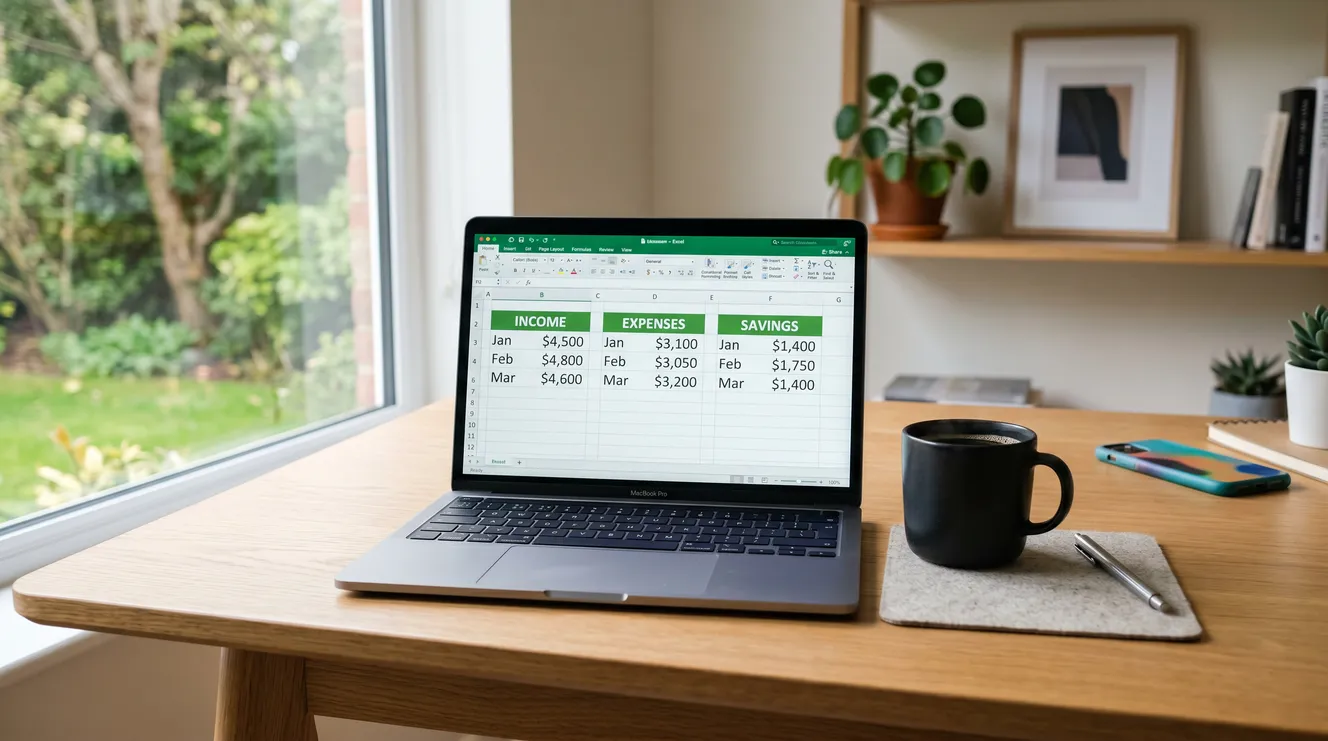
The budgeting app industry is a masterclass in marketing over mechanics. Every new launch promises automation, intelligence, and “effortless” financial wellness. The reality, as financial educators have noted for years , is that apps are too easy to ignore. Their notifications get buried beneath texts, social alerts, and spam. Their dashboards require just enough maintenance—correcting miscategorized transactions, reconnecting broken bank feeds, splitting receipts—to feel like unpaid data entry. When the novelty wears off, what remains is a chore dressed in a slick interface. The spreadsheet, by contrast, is boring by design. It does not demand your attention. It waits for it. And in the gap between those two philosophies lies the difference between a system you abandon and a system you keep.
This is not a Luddite argument. There is genuine value in automation, and some households thrive with digital envelopes and real-time sync. But the data on retention tells a sobering story. Most people do not need a better app. They need a worse one—slower, more manual, and less distracting. A tool that forces you to look at your money rather than glance at it. A tool that cannot be ignored because ignoring it means the row stays empty. That tool is the humble spreadsheet, and its superiority is rooted in psychology, not technology.
The Automation Trap: Why “Set It and Forget It” Becomes “Set It and Abandon It”
Budgeting apps sell a seductive promise: link your accounts, and the software will track everything automatically. You will know where every dollar goes without lifting a finger. The problem is that fingers are precisely what create awareness. Research on manual budgeting shows that physically recording income and expenses slows you down in a beneficial way, forcing you to think through where your money is going. Automation skips that reflection. You see a number, but you do not feel the transaction. The result is a dashboard full of data and a brain full of indifference.
Then the automation breaks. Plaid’s developer data reveals that 34% of bank sync connections require re-authorization within ninety days. When the sync fails, 68% of users choose to stop using the app rather than reconnect. The seamless experience has become a seam, and the seam has become an exit ramp. A spreadsheet never asks for your password again. It never loses connection to your bank because it was never connected. It is a static document that you update on your terms, which means it is always available and never broken.
The maintenance burden is equally underestimated. As one financial coach observed , even with automatic sync, you still have to log in regularly to make sure the app is categorizing correctly. The liquor store gets tagged as groceries. The reimbursed work lunch gets tagged as personal dining. The transfer between your checking and savings gets tagged as income. Fixing these errors takes time, and if you do not do it promptly, the data becomes garbage. At that point, you might as well have been using a spreadsheet all along—at least a spreadsheet does not pretend to be smarter than you.
The Guilt Dashboard: How Apps Make You Feel Broke Even When You Are Not
The dominant visual language of budgeting apps is binary: green when you are under budget, red when you are over. It seems intuitive, but it is psychologically toxic. The average household exceeds at least one budget category per month. Two or three months of red dashboards and users begin to self-identify as “bad at budgeting,” then disengage entirely. UX research confirms that apps using percentage-based progress visualization rather than over/under indicators show 43% higher day-thirty retention. The framing determines whether the experience feels like progress or failure.
Spreadsheets do not judge you. A number in a cell is neutral. It does not flash. It does not buzz. It does not assign an emotional color to your grocery run. You can look at your dining spending for the month, note that it is higher than last month, and decide whether that matters without the software implying you have committed a moral failing. This neutrality is essential for long-term engagement. Money is already emotional. Your tracking tool should not pour gasoline on the anxiety.
There is also the issue of precision without purpose. Apps love to categorize every transaction into micro-buckets—fast food, coffee, convenience stores, delivery apps—then serve you a pie chart showing exactly how your money fragmented. CFPB research found no significant savings-rate advantage for users tracking at the category level versus the total-spending level. The signal that actually correlates with financial wellbeing is multi-month trend direction: are total expenses trending up, down, or flat? Most apps bury this trend view while making the transaction list the primary interface. You are drowning in detail while starving for insight.
The IKEA Effect: Why Building Your Budget Makes You Stick With It
There is a well-documented cognitive bias called the IKEA effect: people place disproportionately high value on things they partially create themselves. A spreadsheet is the ultimate IKEA product. You build the categories. You write the formulas. You choose the color coding. Financial educators note that this sense of ownership deepens commitment. You revisit the budget regularly not because an app nags you, but because you built it and you care about its integrity.
Apps, by contrast, are prefabricated. You rent them. You do not own the data model, the category structure, or the export format. When the company raises prices—as YNAB did repeatedly , climbing from $84 to $109 per year—or shuts down entirely, as Mint did in early 2024, you are left scrambling to migrate years of financial history into a new walled garden. A spreadsheet file on your hard drive does not vanish because a Silicon Valley boardroom decided to pivot. It does not raise subscription fees. It does not lock your data behind an API. You own it in the most literal sense, and that ownership breeds persistence.
The manual process also functions as a spending filter. When you know you will have to type the transaction into a spreadsheet later, you think slightly harder at the point of purchase. Behavioral research supports that this micro-pause impacts spending behavior. The app, by automating the recording, removes the pause. You swipe, you forget, you move on. The spreadsheet makes you a participant in your own financial life rather than a passive consumer of your own data.
The Boring Ritual: A 15-Minute System That Actually Lasts
The most common objection to spreadsheets is time. “I do not have an hour every week to type in receipts.” Fair. You do not need an hour. You need fifteen minutes, once a month, with a simple structure. The reason most spreadsheet budgets fail is the same reason most app budgets fail: over-engineering. If your spreadsheet has forty-seven categories, pivot tables, and a macro that emails you at midnight, you have built a second job. The boring budget is intentionally underwhelming.
Here is the entire architecture. One sheet. Four columns: Date, Description, Category, Amount. Six to eight categories total: Housing, Groceries, Dining Out, Transportation, Utilities, Subscriptions, Savings, and Everything Else. At the end of each month, spend ten minutes copying your bank transactions into the sheet. Spend five minutes looking at the sums. That is the ritual. No pie charts. No progress bars. Just addition and subtraction.
This minimalism is strategic. Financial planners have long argued that most people do not want to record every dollar they spend or feel anxiety about every purchase. They want a simple set of numbers that answers the most critical question: am I spending less than I earn each month? The spreadsheet answers this directly. The app obscures it behind design.
The Boring Budget Template
Column A: Date
Column B: Description (payee or transaction note)
Column C: Category (limit to 6–8 broad buckets)
Column D: Amount (positive for income, negative for spending)
Monthly Ritual: Export bank transactions, paste into sheet, categorize in bulk, check the bottom-line sum. Time required: 10–15 minutes.
The Notification Lie: Why Nagging Does Not Change Behavior
Budgeting apps love notifications. You are approaching your dining limit. You have spent 80% of your grocery budget. You have a bill due tomorrow. The theory is that nudges promote awareness. The reality is that they promote numbness. As one financial coach put it , if she had a dollar for every person who confessed that Mint alerts eventually drove them crazy, she could afford a personal chef. Your phone is already a casino of pings. Adding money anxiety to the notification stream does not make you more disciplined. It makes you more likely to mute the app entirely.
Spreadsheets do not nag. They sit there, quietly accurate, waiting for you to engage when you are ready. This respects the reality of financial attention. Most people do not need daily budget updates. They need a monthly checkpoint where they review the landscape, make one or two adjustments, and return to living. The spreadsheet accommodates this rhythm. The app, with its daily reminders and real-time alerts, assumes you want to think about money constantly. Most people do not. They want to think about it intentionally, then stop thinking about it.
The “Hybrid” Mirage: Why Two Systems Are Worse Than One
A popular compromise is the hybrid workflow: use an app for automatic aggregation, then export the data into a spreadsheet for analysis. This sounds elegant. It is usually a duplication of effort. Proponents of the hybrid approach argue that it separates data collection from analysis, but what it actually does is create two maintenance obligations. You still have to fix the app’s miscategorizations before exporting. You still have to reconcile the exported CSV against your actual statements. You have taken the friction of one system and combined it with the friction of another.
For most households, the hybrid is overkill. If your financial life is complex enough to require automated aggregation—multiple business accounts, rental properties, investment tracking across brokerages—then yes, a spreadsheet alone may strain under the volume. But if your financial life consists of one checking account, one savings account, and a few credit cards, the hybrid is a solution looking for a problem. The boring budget works precisely because it rejects the complexity that the hybrid embraces. You do not need a data pipeline. You need a habit.
The Subscription Math: When the Tool Costs More Than the Insight
There is a quiet absurdity in paying a monthly fee to learn that you are spending too much money. Yet the premium budgeting app market now routinely charges $60 to $180 per year. Post-Mint market analysis shows that most replacement apps occupy this price band, and user resentment is climbing alongside the cost. The question is not whether the app is good. The question is whether any app is worth $109 annually when a free spreadsheet answers the same fundamental question: are you spending less than you earn?
For someone just beginning to budget, a subscription fee is a perverse incentive. It adds another fixed expense to the very budget you are trying to reduce. It creates a sunk-cost fallacy that keeps you using a tool you have outgrown or never needed. The spreadsheet costs nothing. Google Sheets is free. Excel is bundled with most computers. LibreOffice is open source. The absence of a price tag removes the pressure to justify the purchase, which removes the pressure to use the tool even when it is not serving you.
When Apps Make Sense (and When They Do Not)
To be fair, there are households for whom an app is genuinely useful. If you have ADHD and need external prompts to remember bills, an app’s notification system may be a lifeline. If you are juggling five credit cards, two business accounts, and a rental property, automated aggregation saves real time. If you are in a household where multiple people need real-time visibility into shared spending, app-based collaboration beats emailing spreadsheet versions back and forth.
But these are edge cases, not defaults. The majority of people trying to budget are individuals or couples with one to two checking accounts, a savings account, and a credit card. They do not need a fintech platform. They need a habit. And the habit forms faster when the tool is boring, cheap, and entirely under their control. The app is a power tool. The spreadsheet is a hammer. Most budget problems are nails.
The Boring Budget Wins Because It Refuses to Entertain You
The financial technology industry has spent a decade trying to make budgeting fun. Gamification. Pie charts. Push notifications with confetti animations. The result is an industry where 71% of users vanish within a month and the average person has tried and abandoned three apps before their thirtieth birthday. The spreadsheet does not compete with this circus because it does not need to. It is not trying to hold your attention. It is trying to hold your data accurately and show you the truth without ornamentation.
The truth is that most people do not need to track every latte. They need to know, once a month, whether their total spending is trending toward their total income. They need to see that number in a format they control, on a timeline they set, without a subscription fee or a login screen. The boring budget is not a downgrade from the app. It is an escape from the app’s demands. It gives you ownership, neutrality, and a ritual so simple it cannot break.
Open a blank sheet. Name four columns. Spend fifteen minutes at the end of this month filling it in. That is the entire system. No download required. No free trial. No re-authentication with your bank. Just you, your numbers, and the quiet satisfaction of knowing exactly where you stand. In a world of financial apps that scream for your attention, the spreadsheet whispers—and that whisper is the only thing most people actually need.